Explain Why There Are Different Numbers of Atp Produced
104 ATP 1 NADHH. NADHH coming from glycolysis ratio during the.

Pin Af E A Pa Human
NADHH coming from glycolysis ratio during the.
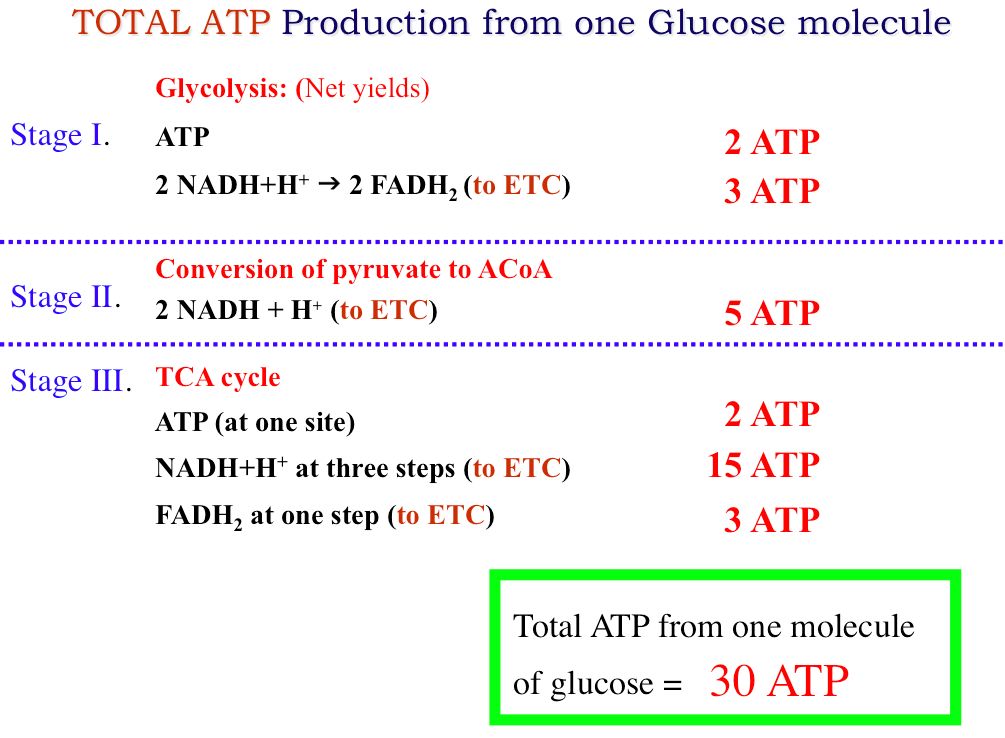
. Fill in the chart below to calculate the total amount of ATP produced from the breakdown of each glucose molecule during the three steps of cellular respiration. Although the theoretical yield can be up to 38 ATP molecules per molecule of glucose this yield is very rarely achieved. There are 10 enzymes involved in breaking down sugar.
The exact number of ATP molecules generated by the oxidation of glucose depends on the point at which the electrons enter the. There is more NADH than FADH 2 made for every glucose that enters cellular respiration. 25 ATP 1 FADH2.
And movement of flagella. Explain why are there different numbers of ATP produced when yeast metabolize. When yeast metabolize glucose aerobically 32 molecules of ATPs are produced from one molecule of glucose.
104 ATP 1 NADHH. What are the products of cellular respiration. It is important to consider at which stages the losses of ATP occur and whyOnce 2 net molecules of ATP are produced after glycolysis which occurs in the cytoplasm pyruvate must be transported into the mitochondrial matrix where the next stage will take.
15 ATP ATP. Although a few of the ATP utilized by cells is produced by substrate-level phosphorylation the majority is produced by oxidative phosphorylation which requires the. The body is a complex organism and as such it takes energy to maintain proper functioning.
Interestingly overexpression of wild-type AGCs but not mutants lacking the Ca 2-binding sites enhanced the upregulation of ATP production upon cell stimulation confirming that different Ca 2-effectors enzymes carriers located in different mitochondrial fractions matrix intermembrane space may cooperate in ATP-producing capacity. Glycolysis takes place in the cytoplasm. ATP can be produced in various ways.
The maximum number of ATP possibly produced is 38 but it is often not reached due to losses leaky membranes as well as the cost of moving pyruvate and ADP into the mitochondrial matrix. Up to 256 cash back 3Explain why fermentation is necessary in cells that do not have access to oxygen â talk about the role of NADH. View the full answer.
2 ATP molecules each donate a phosphate group to each side of the glucose molecule. Here is how this 2 ATP gets produced. 64 ATP 1 FADH2.
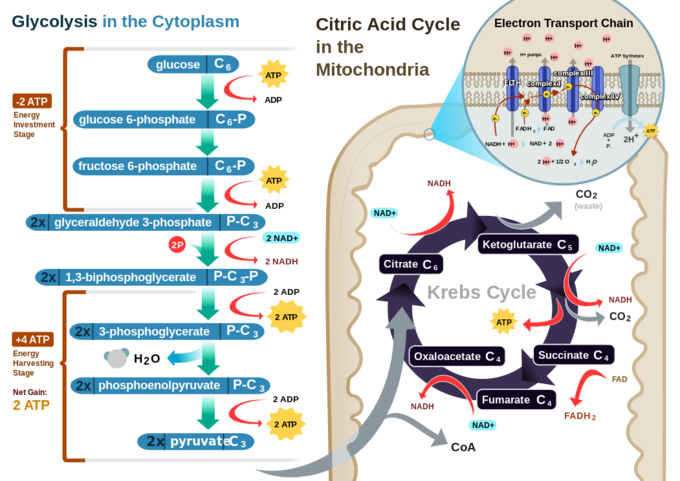
Glycolysis is the process of breaking down glucose. ATP Adenosine Triphosphate is the general currency of energy in cells it is what living cells utilize for activities requiring energy like muscle contraction. B The H gradient made from electron transport using NADH is located in a different part of the mitochondrion than the H gradient made using FADH 2.
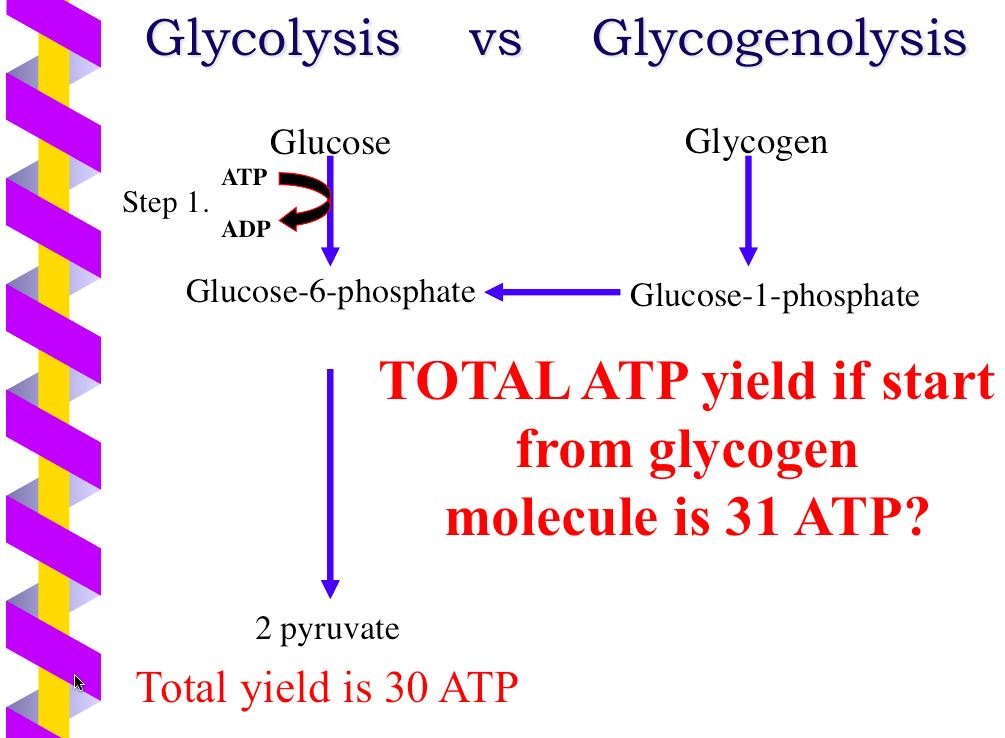
An enzyme cuts the sugar in half. 15 ATP ATP. The 2 NADH they produce enters the same step of the ETC as the other NADH meaning they get 25 ATPall NADH so add an extra 2 to the glycolysis NADH for a total of 32 ATP.
10 protons pumped by NADH. 25 ATP 1 FADH2. 4For what is the NADH and FADH2 produced during the Krebs cycle used.
Describe the production of ATP by substrate-level phosphorylation in different stages of respiration with reference to the number of ATP molecules produced. 2 NAD electron carrierss enter and take 2 H one from each half. And 4 protons needed by ATP synthase to make one ATP molecule.
This is one of the main purposes of glycolysis - to make electron carriers for the final stage. When each FADH 2 gives up electrons and hydrogen ions there is enough of a potential energy change to make two ATP molecules. Glycolysis can take place with or without oxygen.
Adenosine triphosphate ATP is the source of energy for use and storage at the cellular level. Coli is bacteria and bacteria use their plasma membranes to establish a proton gradient for the electron transport chain. When metabolism of glucose is aerobic the end product of glycolysis pyruvate enters into the oxidative phosphorylation occurs in mitochondria.
The NADs becomes NADH. Scientists dont yet know exactly how many protons are pumped in the respiratory chain but the current estimates are. Under aerobic conditions the NADH produced by glycolysis enters the mitochondria of the cell where it becomes oxidized to regenerate NAD by donating electrons to the electron transport chain which results in the production of nearly 90 of the 36-38 ATP molecules produced per glucose molecule metabolized aerobically.
2 FADH2 Mitochondria 15 3 ATP Total. This completely oxidizes all carbons of glucose into CO2 and produces the maximum energy poss. Potential energy change to make three ATP molecules.
There are 2 NADH produced in the second phase of the glycolysis. So the final stoichiometry is 1 NADHH. Each stage of respiration contributes to the production of ATP.
If however the malate-aspartate shuttle is used a total of 5 ATP is produced. If the electrons from NADH are transferred to the Q-pool via the glycerol 3-phosphate shuttle only 3 ATP are produced. Two ATP molecules are used at the start of glycolysis to.
The structure of ATP is a nucleoside triphosphate consisting of a nitrogenous base adenine a ribose sugar and three serially bonded phosphate groups. Glycolysis produces two molecules of pyruvate two molecules of ATP two molecules of NADH and two molecules of water. So the final stoichiometry is 1 NADHH.
This means that each NADH can make 25 ATPs 104 and each FADH can make 15 ATPs 64. 6Products of photosynthesis are. But when yeast metabolize glucose anaerobically only 2 molecules ATP are produced from one molecule of glucose.
Because in aerobic respiratio View the full answer. 64 ATP 1 FADH2.

Easy Method For Making A Photosynthesis Concept Map With Example Photosynthesis Concept Map Photosynthesis Activities

Pin On Nuyugen
7 4c Atp Yield Biology Libretexts
Atp Production Of One Glucose

Pin On Things To Wear

Yann Le Meur On Twitter Sports Low Intensity Workout Sports Medicine

Enzymes Classification And Kinetics Notes Studocu Biochemistry Biochemistry Notes Science Notes
How Do We Get 4 Atp Molecules In Glycolysis Quora

How Is Atp Produced Exercise Physiology Physiology Exercise
Atp Production Of One Glucose

Cellular Aerobic Energy Production Also Known As Cellular Respiration Aerobic Oxidation And Oxidative Phosphorylation Cellular Respiration Oxidative Phosphorylation Photosynthesis And Cellular Respiration

Pin On Teaching Biology

The 7 800 Rpm Motor That Powers Everything You Do Atp Synthase Look At The Almost Mechanical Complex That Gives You Eve Study Biology The Incredibles Chemistry

Connecting Cellular Respiration And Photosynthesis Ck 12 Foundation Cellular Respiration Photosynthesis Cellular Respiration Activities

Anaerobic Respiration Biology Lessons Cell Processes

Follow The Best And Proper Energy Diet Plan To Increase The Atp Production Know How The Energy Restoration Diet Works Without Affe Energy Diet Diet Chart Diet

Cellular Respiration Takes In Food And Uses It To Create Atp A Chemical Which The Cell Uses For Energy

Cellular Respiration Biology Classroom Teaching Biology Biology Resources

Awesome Atp Energy Comic Book Science Biology Teaching Biology Biology Humor


Comments
Post a Comment